


How To Overcome The Bottleneck Of CHO Cell Monoclonal Screening? Four Strategies Achieve Accelerated Progression
Jan 07, 2026
Leave a message
The key bottleneck of CHO cell line construction: efficient screening of monoclonal clones
The construction of CHO cell lines is a systematic and complex process, which mainly includes gene transfection, cell screening, clone expansion, and stability assessment. The monoclonal phase is a key step in the construction of CHO cell lines, which ensures that each cell line is derived from a single ancestor and avoids the interference of genetic heterogeneity, thus ensuring the consistency of drug expression level and the stability of product quality. Strict control of this link is an important guarantee for the safety and effectiveness of biological drugs. However, this critical step is often the most time-consuming and variable step in the entire development process due to the low rate of clone formation and slow growth.
Breaking the bottleneck: four optimization strategies for CHO cell monoclonal screening
How can this critical bottleneck be overcome? Here are four core strategies to show you the way:
01. Transfection optimization: lay the foundation for high-yield cloning
Using efficient transfection reagents and appropriate transfection parameters to improve the efficiency of gene introduction, increase the number of effective integrated cells from the source, and provide the possibility of obtaining more monoclonal clones.
02. Precise sorting: ensure high clone purity
For example, fluorescent-activated cell sorting (FACS) or magnetic bead sorting technology can be used to isolate target cells efficiently, greatly improve the purity of monoclonal population, and reduce the workload of subsequent screening.
03. System empowerment: achieve high-throughput automatic screening
Automated clone screening systems, such as ClonePix FL, can be used for rapid, lossless and high-throughput screening, greatly improving the throughput and objectivity of screening.
04. Medium and culture system optimization: provide key growth support
Optimizing the medium composition and culture environment (such as adding specific growth factors, precise control of pH/ dissolved oxygen) provides the most direct driving force for the growth and proliferation of clonal cells, which is the cornerstone of improving the formation rate and growth rate.
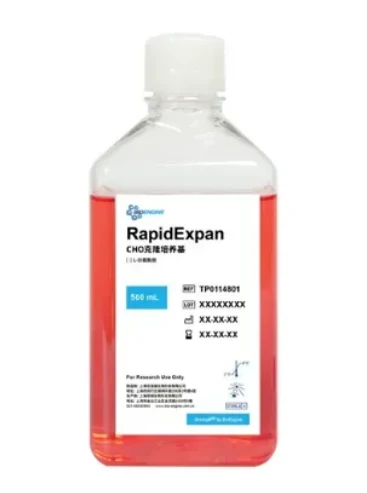
Mastering the above strategies can systematically improve the efficiency of monoclonal screening. If you are looking for a reliable and efficient media solution, BioEngine's RapidExpan CHO cloning medium can help you:
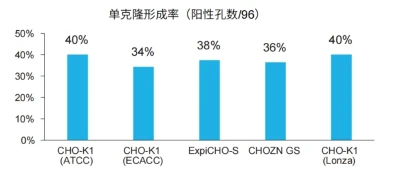
A variety of CHO cell lines were supported for monoclonal growth
The results of limiting dilution method (0.5 cells/ well) showed that the average monoclonal formation rate in CHO-K1, ExpiCHO-S and CHOZN cell lines reached 34%-40%. The results showed that RapidExpan CHO cloning medium could efficiently support the single-cell growth and colony formation of different CHO cell lines.
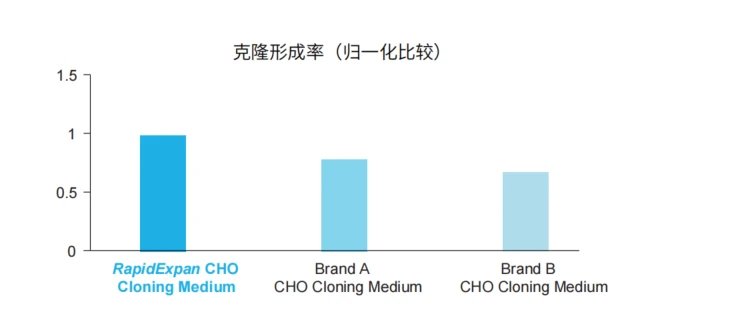
The clone formation rate was significantly improved
The colony formation rate of RapidExpan CHO cloning medium was used as the benchmark (normalized treatment) for comparison. Using the ATCC CHO-K1 cell line for platting, the clone formation rate of RapidExpan CHO clone medium was significantly higher than that of other branded media at Day11.
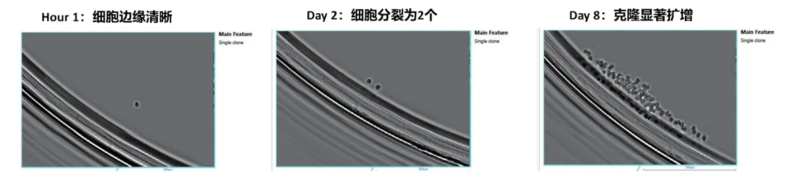
Monoclonal formation case: RapidExpan CHO medium significantly improved the efficiency of monoclonal screening
At the monoclonal screening stage, CHO cell growth and clone formation were not supported by the use of other branded media. Changes to RapidExpan CHO medium significantly improved cell growth status and increased colony formation rate. The lower panel shows the clonal growth from Day 0 to Day 8.
Minipool screening and expression case: screening efficiency, project cycle and clone yield were better than other brands
In the PET therapeutic protein-stable cell line construction project, 48h after electroporation, minipool plating was performed at 2000 cells/ well and puromycin pressure selection was applied simultaneously. RapidExpan CHO could complete clone formation in 15 days, 6 days shorter than Brand A (21 days). A total of 468 positive clones were detected in 5 plates, 33.7% higher than that of Brand A.
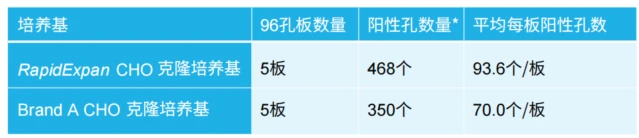
* Wells capable of detecting protein yield
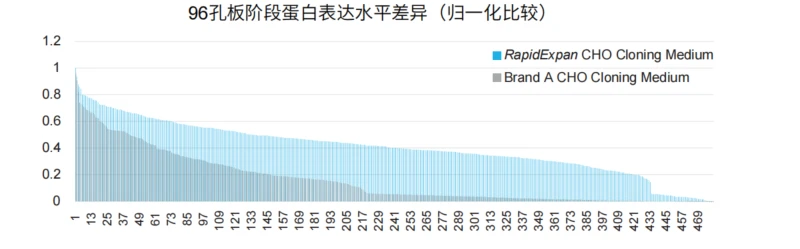
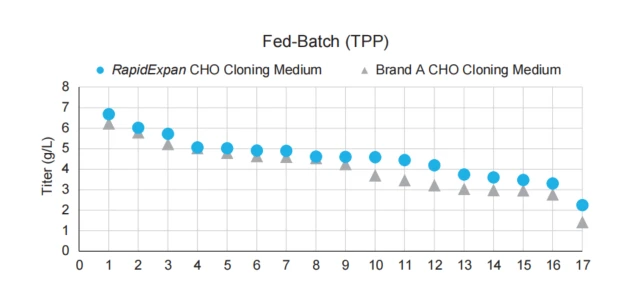
Yield analysis by Gator showed that the supernatant yield of RapidExpan CHO cloning medium (day 15) was significantly better than that of Brand A medium (day 21). At the same time, the yield of the top 17 highly expressed clones selected from each group was better than that of Brand A by using Eden B101 Ultra kit. The above data indicate that RapidExpan CHO cloning medium has significant advantages in the three key dimensions of screening efficiency, project cycle, and clone yield.
Reference
1.Lai, T., Yang, Y., & Ng, S. K. (2013). Advances in Mammalian Cell Line Development Technologies for Recombinant Protein Production.Pharmaceuticals,6(5), 579-603. https://doi.org/10.3390/ph6050579
2.Lim, U. M., Yap, M. G., Lim, Y. P., Goh, L. T., & Ng, S. K. (2013). Identification of autocrine growth factors secreted by CHO cells for applications in single-cell cloning media. Journal of proteome research, 12(7), 3496–3510. https://doi.org/10.1021/pr400352n
3.Welch, J. T., & Arden, N. S. (2019). Considering "clonality": A regulatory perspective on the importance of the clonal derivation of mammalian cell banks in biopharmaceutical development. Biologicals : journal of the International Association of Biological Standardization, 62, 16–21. https://doi.org/10.1016/j.biologicals.2019.09.006
4.Yang, W., Zhang, J., Xiao, Y., Li, W., & Wang, T. (2022). Screening Strategies for High-Yield Chinese Hamster Ovary Cell Clones. Frontiers in bioengineering and biotechnology, 10, 858478. https://doi.org/10.3389/fbioe.2022.858478