


News Update | Tecelra, The World’s First TCR-T Therapy, Launches With Remarkable Clinical Trial Outcomes
Jan 28, 2026
Leave a message
NEWS
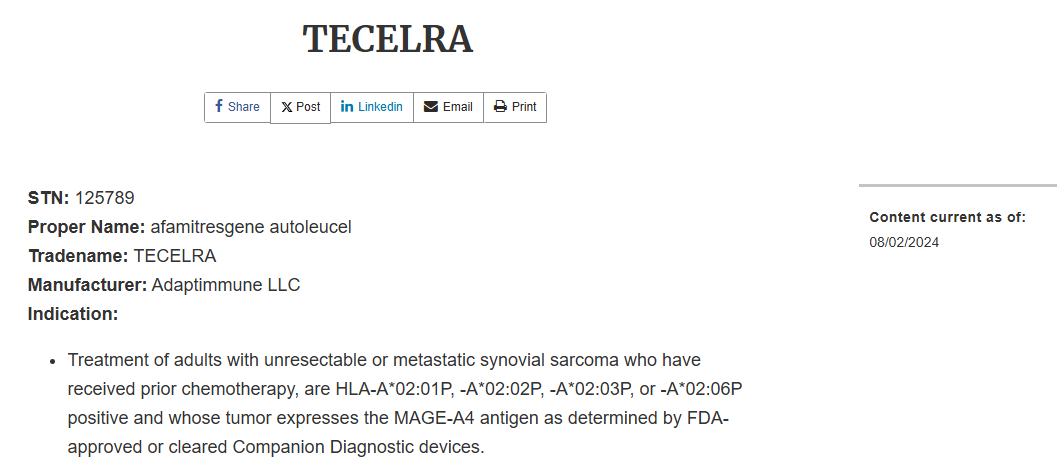
Recently, Adaptimmune announced that the U.S. Food and Drug Administration (FDA) has granted accelerated approval for its TCR-T therapy Tecelra (afamitresgene autoleucel, afami-cel). The therapy is indicated for the second-line treatment of adult patients with unresectable or metastatic synovial sarcoma who have previously received chemotherapy.
Tecelra is the first TCR-T therapy to enter the market, the first cell therapy targeting solid tumors, and also the first new therapy for synovial sarcoma in more than a decade. Backed by multiple "firsts", it represents a significant milestone.
Synovial sarcoma is an extremely rare malignant tumor that develops in bones and soft tissues (including fat, muscles, nerves and blood vessels). It accounts for 5% to 10% of all soft tissue sarcomas and usually affects young people. With high treatment difficulty, the therapeutic effect for patients with synovial sarcoma has been limited in recent decades.
Adaptimmune is a company dedicated to redefining solid tumor treatment through cell therapies. It has 5 investigational TCR-T products, among which 3 have entered the clinical trial stage (including the already marketed Tecelra, whose other indications are in Phase I; the other 2 products have progressed to Phase II/III). Meanwhile, the company is also building an allogeneic cell therapy platform, which is still in the early stage.
Tecelra has also set a new price record for cell therapies, priced at 5.2 million yuan (727,000 US dollars). The price of domestic CAR-T therapies is around 1.2 million yuan, while that of overseas CAR-T therapies ranges from 2.6 million to 3.5 million yuan (370,000 to 480,000 US dollars). The TIL therapy just launched this year is priced at 3.7 million yuan (515,000 US dollars).
Clinical Trial Results of afami-cel
Afamitresgene autoleucel (afami-cel) is a genetically modified T cell therapy. Transduced by lentiviral vectors, it expresses high-affinity TCR targeting the MAGE-A4₂₃₀₋₂₃₉ polypeptide (GVYDGREHTV).
In the Phase I clinical trial of afami-cel (NCT03132922), which was conducted on patients with relapsed/refractory metastatic solid tumors expressing MAGE-A4 (including synovial sarcoma (SS), ovarian cancer and head and neck cancer), the overall response rate (all partial responses) was 24% (9/38), among which 44% (7/16) were synovial sarcoma patients and 9% (2/22) were patients with other cancers. The results showed that afami-cel could infiltrate tumor tissues, exert cytotoxic effects and trigger adaptive immune responses.
Following the publication of the Phase I clinical trial results, Adaptimmune released the Phase II clinical trial results in March this year. Patients received a single intravenous infusion of afami-cel (at a dose of 1.0 × 10⁹–10.0 × 10⁹ T cells) after lymphodepletion. The overall response rate was 37% (19/52), with the overall response rate reaching 39% (17/44) among synovial sarcoma patients. These findings indicate that TCR-T can effectively target solid tumors and provide a theoretical basis for extending this approach to other malignant solid tumors.
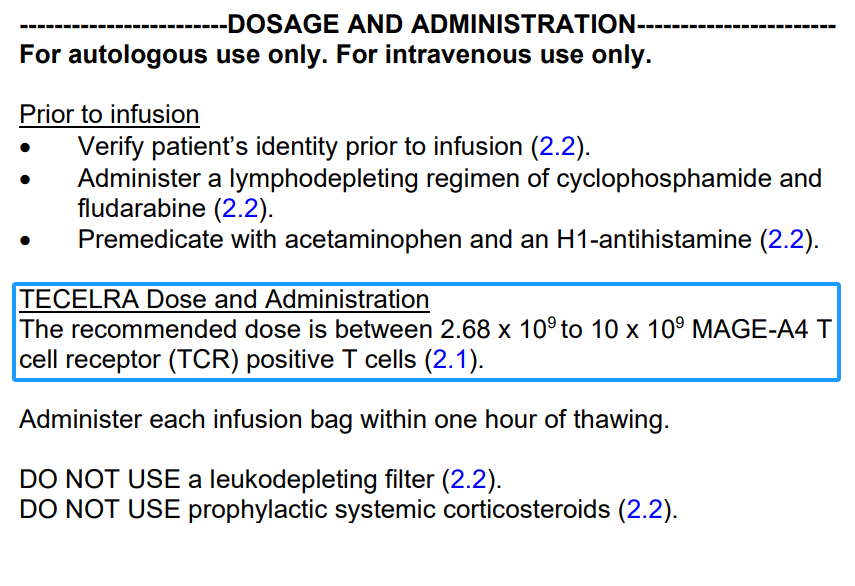
In addition, the recommended dosage of Tecelra approved for marketing this time is 2.68 × 10⁹ to 10 × 10⁹ TCR-positive T cells, which is higher than that of CAR-T therapies (approximately 1 × 10⁶ cells/kg). Amtagvi (TIL) also requires a relatively large number of cells, with a recommended dosage of 7.5 × 10⁹ to 72 × 10⁹ viable cells.
TCR-T and CAR-T
TCR-T (engineered T cell receptor-T cell) and CAR-T (chimeric antigen receptor-T cell) are both therapies that involve modifying T cells to enable them to better recognize tumors and ultimately kill tumor cells for therapeutic effects. Thus, TCR-T and CAR-T are very similar in terms of their basic principles, but there are still many differences between the two.
In terms of antigen recognition, CAR-T can only recognize cell surface antigens, which limits its target selection and, in turn, its range of indications. CAR-T has shown good therapeutic efficacy in hematological malignancies, and all currently marketed CAR-T products are indicated for B-cell malignancies among hematological tumors. In contrast, TCR-T recognizes peptide-MHC complexes, which are not limited to cell surface antigens; intracellular antigens can also be presented to the cell surface by MHC molecules, allowing for a broader range of target choices. Many solid tumor cells lack specific cell surface markers, making TCR-T more suitable for the treatment of solid tumors than CAR-T. Numerous studies have also demonstrated that TCR-T exhibits favorable efficacy in both hematological malignancies and solid tumors. However, the limitations of TCR-T also stem from its antigen recognition mechanism: TCR-T cell therapy is restricted by MHC types, which limits the scope of eligible patient populations.
Additionally, studies have shown that TCR-T induces less cytokine release compared to CAR-T, which can reduce the risk of cytokine release syndrome. CARs are artificially synthesized structures that do not exist in normal cells, whereas TCR structures are naturally occurring. As a result, TCRs have lower immunogenicity, which indicates that TCR-T has better safety profiles.
REFERENCE
1.https://www.fda.gov/vaccines-blood-biologics/cellular-gene-therapy-products/approved-cellular-and-gene-therapy-products
2.https://www.adaptimmune.com/pipeline
3.Hong, David S et al. "Autologous T cell therapy for MAGE-A4+ solid cancers in HLA-A*02+ patients: a phase 1 trial." Nature medicine vol. 29,1 (2023): 104-114. doi:10.1038/s41591-022-02128-z
4.D'Angelo, Sandra P et al. "Afamitresgene autoleucel for advanced synovial sarcoma and myxoid round cell liposarcoma (SPEARHEAD-1): an international, open-label, phase 2 trial." Lancet (London, England) vol. 403,10435 (2024): 1460-1471. doi:10.1016/S0140-6736(24)00319-2